Marble Flooring in Dubai: Choose, Install and Look After a Marble Floor
Dubai Repair Pro is a Dubai LLC with its own team of installers. We lay new marble floors in apartments, villas and commercial spaces: living areas, entrances, stairs, bathrooms and outdoor areas. Marble is not a forgiving material. It marks, stains, shows uneven bases and punishes shortcuts, so the work is mostly decisions and preparation before a single slab is set.
Last updated: 13 October 2026
On this page
- Marble flooring services in Dubai: what we cover
- Choosing marble: types, finishes and what they mean
- The best indoor marble flooring in Dubai
- Top marble outdoor flooring in Dubai
- How we install a marble floor
- Sealing marble before and after grouting
- How long a marble floor job takes
- Cleaning and caring for a marble floor
- Marble or marble-effect porcelain?
- Marble flooring cost in Dubai
- Choosing the best marble flooring services in Dubai, UAE
- Marble flooring Dubai: where we work and how to get a quote
- Frequently asked questions about marble flooring in Dubai
This page covers how to choose marble and its finish, what suits indoor and outdoor floors, how we install and seal a marble floor, how long it takes, how to look after it, how marble compares with marble-effect porcelain, what marble flooring costs in Dubai and how to choose an installer. If your floor is already laid and needs restoring, our marble polishing page covers polishing, honing and repair. For fixing methods that apply to every tile type, see our tile fixing page. For the cost side of tiled floors, see the tile price guide.
The quickest way to start is to send photos of the area on WhatsApp at +971 55 209 9785, with the approximate size. Some floors we can price from photos, and others need a visit. A site inspection costs AED 100.
Marble flooring services in Dubai: what we cover
We offer marble flooring in Dubai as a new floor, a replacement of an existing floor, and a finishing job such as stairs, borders and skirting. The table below lists the main marble jobs and who usually books each.
| Job | What it covers | Who usually asks |
|---|---|---|
| New marble floor | Living areas, corridors, entrances, kitchens | Owners of new or renovated homes |
| Replacing an existing floor | Removing old tile, marble or other flooring and laying new marble | Owners upgrading |
| Stairs, risers and landings | Marble treads, risers, nosings and landings | Villa and duplex owners |
| Skirting, borders and thresholds | Marble skirting, border strips, door thresholds | Anyone completing a floor |
| Bathrooms | Marble floors and walls in wet areas, with waterproofing | Owners who want a premium bathroom |
| Outdoor marble | Terraces, balconies, entrances and pool surrounds, where marble suits | Villa owners |
| Commercial marble | Lobbies, showrooms, hotel and office floors | Businesses, fit-out teams |
| Cutting and layout | Marble cut to the room's layout, patterns and borders | Owners with a design in mind |
The same team that quotes your job lays it. We employ our own installers and do not subcontract the fixing.
We can supply the marble and fix it under one quote, or fix marble you have bought. If you buy your own, we check the delivery for quantity, breakage, thickness and batch before we start, and we report any problems to the supplier. We also help you choose.
If the floor also needs waterproofing, painting or a polish later, one team handles it, so no trade is waiting on another and no trade damages a finished floor.
Choosing marble: types, finishes and what they mean
Choosing marble comes down to three decisions: the stone, the finish and the thickness. Each changes how the floor looks, how it wears and what it costs.
The stone
Marble is a natural stone, and no two slabs are the same. The names below are widely sold, and we describe them by appearance only. Ask the supplier for the origin, grade and a full-size sample.
| Marble | Appearance |
|---|---|
| Carrara | White to soft grey, with fine grey veining |
| Calacatta | White with bold, dramatic veining |
| Thassos | Very white, with little veining |
| Crema Marfil | Warm beige, with soft markings |
| Emperador | Brown, with lighter veining |
| Nero Marquina | Black with white veins |
Names are used loosely in the market, and two marbles sold under the same name can look different. Judge the stone from the slab or a large sample, not from a name or a small chip.
Veining and variation
Veining is the pattern of lines in the stone. A floor with strong veining looks dramatic, and the pattern changes from slab to slab. We lay the stone out dry, before fixing, so the veining runs the way you want, and so that darker or lighter slabs are spread across the floor and not clustered in one corner. If you want a continuous, book-matched look, tell us at the start, because it affects how much marble you buy.
The finish
The finish is how the surface has been worked. It decides how shiny, how slippery and how hard to keep the floor is.
| Finish | What it looks like | Slip when wet | Care |
|---|---|---|---|
| Polished | Glossy, mirror-like | Slipperier | Shows scratches and etching, can be re-polished |
| Honed | Matt, soft, velvety | Better grip than polished | Hides light scratches, still needs sealing |
| Brushed or textured | Slightly rough, natural | Best grip of the three | Holds dirt in the texture, needs a brush |
Polished marble is the slipperiest of the three when wet, and honed marble gives noticeably better grip, though it still needs care when wet. We cannot give you a slip number for a finish in general, because a rating belongs to a specific product. Ask the supplier for the slip rating of the finish you choose, and test a sample with a wet foot before you buy.
Honed marble also hides light scratches better than polished and can be refinished by a professional later, which is why it is the practical choice for a busy home.
Thickness and flatness
Marble tiles and slabs come in different thicknesses. Thin tiles are lighter and need a firm base. Thicker slabs are heavier and more forgiving to handle. We check that all pieces are the same thickness before we start, because a mix produces an uneven floor. Large slabs also have to be flat, and we check them with a straightedge on delivery.
Checking the delivery
On delivery, we check:
- Quantity, including 10 per cent extra for cutting, and more for patterned layouts.
- Breakage and chips, on edges and corners.
- Batch and shade, with all boxes from the same batch where possible.
- Thickness and size, the same across pieces.
- Surface finish, the same on every piece.
If something is wrong, we photograph it and report it before work starts, because a tile fixed in place is a tile accepted.

The best indoor marble flooring in Dubai
The best indoor marble flooring in Dubai for your home is the one that suits the room, not the most expensive stone. Each room asks something different of a floor.
| Room | What matters | What we suggest |
|---|---|---|
| Entrance and hallway | Grit from shoes, heavy use, first impression | A honed finish, a darker or veined stone that hides marks, a doormat |
| Living and dining areas | Large area, visible veining, furniture | A polished or honed stone, laid out carefully, with felt pads under furniture |
| Kitchen | Spills, oil, acids, dropped items | Honed and well sealed, or a different material; marble etches with lemon, vinegar and tomato |
| Bathroom | Water, soap, bare feet | A honed or textured finish, waterproofing under it, regular resealing |
| Bedrooms | Comfort and quiet | A honed finish, or marble in a hall and another floor in the bedrooms |
| Stairs | Safety, edges, wear | A honed or brushed finish, with grip strips or a textured nosing |
Kitchens
Marble reacts with acids. Lemon juice, vinegar, wine and some cleaners dull the surface, leaving marks called etching. Sealing slows staining, but it does not stop etching. If you cook a lot and do not want visible marks, a honed finish hides them better, and some owners prefer a harder material in the kitchen and marble elsewhere. We say so at the inspection.
Bathrooms
Marble in a bathroom looks expensive and needs care. The floor must be waterproofed, the stone sealed and the finish chosen for grip. Polished marble on a wet bathroom floor is a slip risk. For details on wet-room tiling, see our bathroom and kitchen tiles page.
Stairs
Stairs need grip at the edge. We use a honed or brushed finish, and where needed add a textured nosing or grip strips. Marble stairs are cut, edged and set carefully, and the quote lists treads, risers, nosings and landings separately.
Open-plan homes
If the floor runs through several rooms, we plan movement joints at the thresholds and where the floor is long, so the stone can move without cracking. We also plan how marble meets other floors, so heights match and thresholds are safe.
If you want the same marble throughout
A single marble across a whole home gives the most unified look, and it is the most expensive. A common compromise is marble in the entrance, living and dining areas, and a warmer or cheaper floor in the bedrooms. We help you decide where marble is worth the cost.
Top marble outdoor flooring in Dubai
Outdoor marble flooring in Dubai looks excellent, and it asks more of the owner than an indoor floor. Sun, heat, rain, dust and cleaning chemicals all work on it. We tell you plainly when marble outdoors is a good idea and when it is not.
What marble faces outside
| Condition | What it does to marble |
|---|---|
| Direct sun | The surface heats up, and dark stone gets hotter than light stone |
| Rain and wet surfaces | Polished marble becomes slippery |
| Dust and sand | Scratch the surface, and dull polished finishes |
| Pool and garden chemicals | Chlorine and acids etch the stone |
| Temperature swings | Movement in the floor, so movement joints matter |
| Water seeping from below | Staining, and efflorescence on the surface |
Finishes for outdoor marble
If you choose marble outdoors, choose a surface with grip. A polished finish is a poor choice outside. A honed, brushed or textured finish gives better grip and hides wear. We recommend a light colour for sun exposure, and we recommend you test a sample with a bare foot in the afternoon sun before you commit.
What we plan for an outdoor floor
- A fall to the drain, so water does not sit on the surface.
- Waterproofing, on balconies and terraces above a living space.
- Movement joints, at set distances and at edges.
- A suitable adhesive and grout, for outdoor use.
- Sealing, with a sealer suited to outdoor use and reapplied on schedule.
When not to use marble outdoors
Marble is not the best choice for every outdoor floor. A pool surround that is constantly wet, a driveway that takes vehicles, or a sunny terrace with no shade often suits a different material better. Travertine, granite and outdoor-rated porcelain are common alternatives, and porcelain in a marble-effect finish gives the look with less upkeep. We say which we would choose, and why, at the inspection.
Maintenance outdoors
Sweep regularly, wash off dust and salt, and avoid acid-based cleaners. Reseal on the sealer manufacturer's schedule, and check joints and sealant each year. Outdoor marble also needs more frequent re-polishing or honing than an indoor floor, and our marble polishing team can restore it.
How we install a marble floor
Laying marble is slower and more careful than laying ceramic. The stone is heavy, expensive and easy to mark, and the base has to be right before any slab goes down.
Step 1: Inspection. We check the base, measure the area, note levels, moisture and repairs, and agree the marble, finish, layout and joints. The inspection fee is AED 100, and a written quote follows.
Step 2: Protection and removal. Floors, walls and fittings are covered. An existing floor is removed, the debris is cleared and the base is exposed.
Step 3: Base preparation. The base is repaired, cleaned, levelled and checked for moisture. Marble needs a flatter base than most tile, because it shows every dip.
Step 4: Waterproofing. Wet areas, balconies and terraces get a waterproofing membrane, which cures before the stone goes down.
Step 5: Dry layout. The marble is laid out dry, before fixing, so veining, shade and cuts are planned. We mark the layout and movement joints.
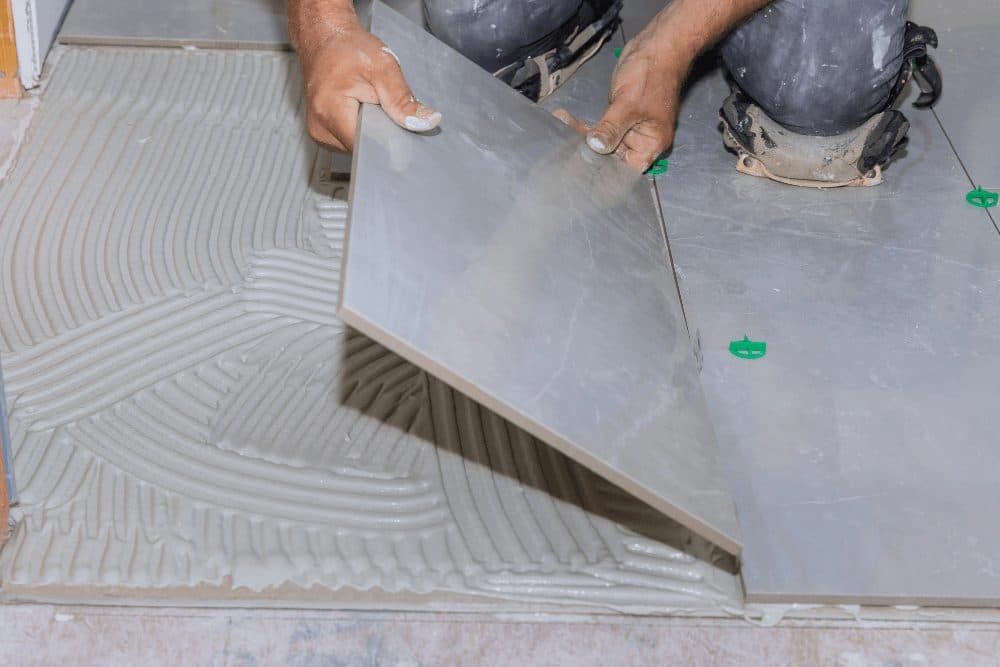
Step 6: Fixing. Slabs are set in an adhesive suited to marble, spread with a notched trowel. Large pieces are set with adhesive on both the base and the back of the stone, called back-buttering, so there are no voids. Each piece is checked for level and flatness as it goes down.
Step 7: Joints. Joints are cleaned out, then grouted. Movement joints are filled with flexible sealant.
Step 8: Sealing and cleaning. The marble is sealed as described in the next section, and the surface is cleaned.
Step 9: Snagging and handover. We walk the floor with you, tap for hollow pieces, check levels, joints and finish, and correct what we find. We explain when the floor can take foot traffic and furniture. The one-year workmanship warranty starts at handover.
Why the adhesive matters
Marble can show the adhesive colour through the stone, especially pale marble, and some adhesives can stain or cause curling in thin marble. We choose an adhesive suited to marble and the colour of the stone, and name it in the quote. We follow the adhesive manufacturer's instructions for mixing, open time and curing.
Joint width
Marble tiles are often cut to a close tolerance and laid with narrow joints. A tight joint looks clean and needs a precise base and layout. We agree the joint width with you, and we choose a grout colour that suits the stone.
Cutting
Marble is cut to the layout, including borders, patterns, stairs, thresholds and around fittings. We plan cuts at the layout stage so waste is low and cut edges fall in less visible places.
Protecting the finished floor
A marble floor is easy to scratch and stain while other trades are still working. After handover, we recommend covering it with protective board or sheeting until painting, joinery and furniture delivery are done. We can cover the floor for you.
Sealing marble before and after grouting
Marble is porous. A spilled drink, a drop of oil or a wet footprint can soak in and leave a mark. A sealer reduces the rate at which liquids soak in, which gives you time to wipe a spill.
Seal before and after
Sealing happens in two stages. We seal the stone before grouting where the stone and grout call for it, so grout does not stain the surface. We seal again after grouting and cleaning, so the whole floor is protected. The product's instructions decide the cure time between stages.
What sealing does and does not do
Sealing slows staining. It does not stop etching, which is a chemical reaction between marble and acids such as lemon juice, vinegar and some cleaning products. A sealed marble still needs spills wiped up promptly.
How often to reseal
Sealers wear off, and the interval depends on the product, the finish, the traffic and the room. Sealer manufacturers publish their own schedules, and we follow the one for the product we use and tell you the interval at handover. A simple test is to drop a little water on the marble: if it soaks in and darkens the stone within a few minutes, it is time to reseal.
Sealing grout
Cement grout also absorbs. We seal the grout with the stone, and use a stain-resistant grout where the floor is likely to get dirty.
How long a marble floor job takes
A marble floor takes longer than a ceramic one, because of the preparation, the layout and the curing. The timing depends on the area, the stone, the state of the base and the layout.
| Job | Typical duration |
|---|---|
| A single room | 3–5 days |
| An apartment floor | 7–12 days |
| A villa floor | 3–4 weeks |
| Stairs | Quoted after inspection |
| Removal of an existing floor | Add 1–3 days depending on the area |
| Waterproofing | Add the membrane's cure time |
These include the time for the adhesive and grout to cure. The adhesive, grout and sealer each have their own times, and we state them in the quote.
First use
A fixed floor can usually take light foot traffic before it is fully cured, and heavy loads later. We tell you when you can walk on it, when furniture can go back and when it is safe to polish or seal further. Heavy appliances and furniture go back last.
What changes the timing
- Pattern and layout. Borders, diagonals and book-matched stone take longer.
- The state of the base. Levelling, repairs and moisture treatment add days.
- Removal. Taking out an old floor adds time and dust.
- Waterproofing. The membrane has to cure.
- Stairs and cuts. Cut and edged pieces are slower to set.
- Building rules. Lift booking, delivery of heavy stone and working hours limit the day.
We follow the working-hour rules of your building or community. Where weekends or evenings are allowed and approved, we use them to shorten the schedule.
Cleaning and caring for a marble floor
A marble floor lasts for decades with simple habits. Most damage comes from the wrong cleaner or a spill left too long.
Daily and weekly care
- Dust and sweep with a soft broom or dust mop. Grit scratches marble.
- Mop with a pH-neutral cleaner made for stone, and clean water. Dry the floor afterwards.
- Wipe spills at once, especially juice, wine, oil, coffee and cooking acids.
- Use mats at entrances and in front of sinks, and felt pads under furniture.
- Take off outdoor shoes, or use a mat, because sand and grit scratch the surface.
What to avoid
- Acidic cleaners, including vinegar, lemon and many bathroom cleaners. They etch marble.
- Abrasive powders and scouring pads. They scratch the surface.
- Bleach and harsh chemicals, which can stain and dull the stone.
- Dragging furniture. Lift it.
- Standing water, which finds its way into the stone and the joints.
This is standard stone care. We give you the same advice at handover, tailored to the sealer and the finish we use.
Stains and etching
A stain is a mark inside the stone, from oil, wine, coffee or rust. Some can be drawn out with a poultice made for stone. Etching is a dull mark on the surface from acid, and it is not a stain. A light etch can be removed by re-polishing, which is a job for our marble polishing team. We tell you which you have, and what it takes to fix.
When to polish or hone
A floor loses its shine over time as foot traffic dulls it. Polishing restores a polished finish, and honing restores a matt one. How often depends on use. A busy entrance wears faster than a bedroom. We can inspect and quote a maintenance plan with periodic cleaning, resealing and polishing.
Marble or marble-effect porcelain?
Marble-effect porcelain is a ceramic tile printed or textured to look like marble. It is a serious alternative, and in some places the better choice. The table compares them honestly.
| Natural marble | Marble-effect porcelain | |
|---|---|---|
| Look | Real stone, each slab unique | A printed or textured pattern, with repeat in the design |
| Staining | Porous, needs sealing, stains if neglected | Dense, resists stains |
| Etching | Etches with acids | Does not etch |
| Scratches | Scratches, can be re-polished | Harder, resists scratching |
| Slip | Polished is slippery, honed is better | Available in textured, slip-rated finishes |
| Upkeep | Sealing, careful cleaning, periodic polishing | Light cleaning |
| Repair | Can be re-honed or re-polished | Cracked tile is replaced |
| Weight | Heavy | Lighter, depending on format |
| Cost | Higher for stone and installation | Lower in most cases |
| Value | Natural stone is valued by many buyers | Seen as an imitation |
| Outdoor | Needs the right finish and care | Outdoor-rated tiles available |
When marble wins
Choose natural marble if you want the real stone, accept the upkeep and plan to maintain the floor. It suits living areas, entrances and bathrooms where you enjoy the material.
When porcelain wins
Choose marble-effect porcelain if you have a busy kitchen, young children, pets, a high-traffic floor or an outdoor area, and you want the look without the upkeep. It also suits rental properties, where care of the floor is not yours to control.
A mix
Many homes use both. Natural marble in the entrance and main living area, and marble-effect porcelain in the kitchen, bathrooms and outdoor areas. We help you choose where each belongs.
Marble flooring cost in Dubai
The price of marble flooring in Dubai has two parts: the stone and the installation. The stone varies enormously by type and finish. The installation follows the area, the layout and the state of the base.
Why a marble rate means little without its scope
A rate per square metre for marble installation is only useful when you know what it includes: the stone, the labour or both, and whether preparation, waterproofing, adhesive and VAT are in it. We do not publish a single rate for that reason. Each floor is quoted in writing after the inspection.
What goes into the price
| Cost | What it covers |
|---|---|
| The marble | The stone, by type, grade, finish and thickness |
| Delivery and handling | Transport, lifting and storage of heavy stone |
| Base preparation | Levelling, repairs, moisture treatment |
| Waterproofing | In wet areas and outdoors |
| Removal of the old floor | Breaking out, debris and disposal |
| Fixing labour | Laying, cutting and setting |
| Adhesive and grout | Marble-suited products |
| Sealing | Before and after grouting |
| Stairs, borders and skirting | Cut and edged pieces |
| Protection | Covering the finished floor |
How we price the work
We do not publish a per-square-metre rate for marble fixing, because the price depends on the stone, the layout, the finish and the condition of the base. Each job is quoted in writing after the inspection. The tile price guide shows how to budget a finished floor.
| Job | Price |
|---|---|
| Marble fixing, labour, per square metre (standard layout on a ready base) | Quoted after inspection |
| Minimum job | Quoted after inspection |
| Stairs, borders and skirting | Quoted after inspection |
| Waterproofing | Quoted after inspection |
| Removal of an existing floor | Quoted after inspection |
| Sealing | Quoted after inspection |
| Supply and fix (marble included) | Quoted after inspection |
Prices are shown before 5% VAT. The price that applies is the written quote after the inspection, which lists each part.
What moves the price
- The stone. Rare, bold-veined and imported marble costs more.
- The finish. Honed, brushed and polished differ in cost.
- Thickness and format. Large slabs are heavier and harder to lay.
- Layout. Patterns, borders and diagonals add cuts and time.
- The base. Levelling and repairs add cost.
- Stairs. Cut and edged pieces are slower.
- Access. Upper floors and heavy loads add handling.
Read a marble flooring quote
| Check | Why it matters |
|---|---|
| Marble named by type, finish and thickness | Prevents a substitute |
| Area and wastage allowance | Stops a low rate hiding a high area |
| Adhesive and grout named | Marble-suited products matter |
| Sealing before and after grouting | A common omission |
| Base preparation, waterproofing and removal | Common extras |
| Stairs, borders and skirting | Often priced separately |
| Protection of the finished floor | Avoids damage after handover |
| VAT shown separately | Five per cent of a whole-floor marble quote is a real sum |
| Payment schedule | A large deposit before the first piece is laid is a warning sign |
| Warranty in writing | A spoken promise is hard to enforce |
A marble quote far below the others may have left out preparation, sealing or protection. Ask each company what it includes, and compare like with like.
Choosing the best marble flooring services in Dubai, UAE
Finding marble flooring services in Dubai is easy. Judging them is harder, because the quality of a marble floor shows later, in how it ages. The best marble flooring services in Dubai and the UAE are the ones that can explain how they will prepare the base, which adhesive they will use and how they will seal the stone. Use this checklist when you compare installers, including us.
- Check the company. Ask to see the trade licence, and match its name to the quote.
- Ask who will lay the marble. Some companies take the booking and hand the job to subcontractors. Ask whether the installers are employees, and meet the supervisor.
- Ask for a sample you can see. A full-size piece in real light, with a wet-foot test for the finish.
- Ask about the base. Levelling, moisture and waterproofing should be in the quote.
- Ask which adhesive they use. The answer should name a product suited to marble and the colour of the stone.
- Ask about back-buttering and flatness. A good installer talks about voids and level.
- Ask about the layout. Marble pieces vary, so a dry layout before fixing shows how the veining and joints will fall.
- Ask about sealing. Before and after grouting, with the product named.
- Ask about protection. How the floor will be covered until other trades finish.
- Check the payment schedule. A small deposit, stage payments and a final payment after the snagging walk is fair.
- Ask about the warranty. Ours is a one-year workmanship warranty. It covers our workmanship, not natural variation in the stone, and the terms are in writing on request.
- Ask for past work you can see. A floor you can visit, a few years old, tells you more than a new photo.
If you are shortlisting, send each company the same photos, the same area and the same marble, so you compare like with like.
Marble flooring Dubai: where we work and how to get a quote
We offer marble flooring Dubai-wide, in every community and building. We work across Dubai, including Palm Jumeirah, Emirates Hills, Jumeirah, Arabian Ranches, Dubai Hills, Damac Hills, Downtown Dubai, Dubai Marina, Business Bay, Al Barsha, Mirdif and Al Safa. If your area is not listed, we cover it too. If you want the best indoor marble flooring Dubai homes can have, the top marble outdoor flooring Dubai terraces allow, or the best marble flooring services in Dubai, UAE-wide for a commercial space, the first step is the same: send us photos.
Marble is heavy, and buildings often limit deliveries. Tell us the building, the floor and the lift capacity when you contact us, and we plan the delivery and the working hours around your building's rules.
Marble quotes depend on the stone and the base, so message us on WhatsApp at +971 55 209 9785 with:
- The building and floor, and whether the property is occupied or empty.
- The job: new floor, replacement, stairs, bathroom or outdoor area.
- The size of the floor, in square metres or square feet.
- The marble, if chosen: type, finish, thickness and whether you supply it.
- Photos of the area, including the existing floor, damp and levels.
- Your preferred dates, and any deadline.
- Building rules: working hours, lift booking, delivery rules.
We reply with what the photos let us price and what needs inspection. The inspection costs AED 100. Our written quote then lists the work, the products, the price before VAT, the schedule and the warranty terms.
Keep reading
Frequently asked questions about marble flooring in Dubai
How much does marble flooring cost in Dubai?
The price has two parts: the stone and the installation. The stone varies by type, finish and thickness, and the installation follows the area, the layout and the base. Two marble quotes can differ widely because they do not cover the same scope. We quote after inspection, and the quote lists the parts separately. Prices are before 5% VAT.
Which marble is best for indoor floors?
A honed finish in a stone that suits the room: a veined or darker stone in an entrance, a polished or honed stone in living areas, and a honed or textured finish in bathrooms and stairs. We suggest the stone at the inspection, and tell you what we would avoid in a kitchen.
Is marble suitable for outdoor floors in Dubai?
Sometimes. It needs a honed, brushed or textured finish, a light colour for sun, a fall to drainage, movement joints and regular sealing. For pool surrounds and driveways, other materials often suit better. We say which at the inspection.
Is marble slippery?
Polished marble is the slipperiest finish when wet, and honed or brushed finishes grip better, though they still need care. A slip rating belongs to a specific product, so ask the supplier for the rating of the finish you choose, and test a sample with a wet foot.
How often does marble need sealing?
The sealer and the use set the interval, and the manufacturer publishes it. We give you the interval for the product we use. A drop of water that soaks in and darkens the stone means it is time.
Can you lay marble over my existing floor?
Sometimes, if the old floor is sound, flat and firmly bonded, though it raises the floor height and adds weight. We tell you at the inspection whether it is suitable, and we recommend removal when it is not.
How long does a marble floor take?
A single room takes three to five days, an apartment floor seven to twelve and a villa floor three to four weeks, including curing. Removal and waterproofing add time. The quote states the schedule.
Can marble be repaired or restored?
Yes. Scratches, etching and dull patches can be re-honed or re-polished, and cracked pieces can be repaired or replaced. Our marble polishing team handles restoration.
Do you supply the marble?
Yes. A supply-and-fix quote covers the stone and the installation together, and we help you choose and order. If you buy your own, we check the delivery for quantity, thickness, breakage and batch before we start.
Do you work weekends and evenings?
Where your building or community allows and approves it, yes. Some fix their working hours and lift times, and we follow them. Tell us your deadline when you ask for the quote.
Get a quote for marble flooring
Tell us what you need, or send photos on WhatsApp. A site inspection costs AED 100, and you get a written quote after the visit.
- +971 55 209 9785
- info@dubairepairpro.com