Tile Fixing in Dubai: Floor and Wall Tiling, Rates and How the Work Is Done
Dubai Repair Pro is a Dubai LLC with its own team of tile installers. We fix tiles on floors and walls in apartments, villas and commercial spaces: ceramic, porcelain, large-format, natural stone and mosaic. We also deal with what sits under the tile, because most tile problems start in the base, not in the tile.
Last updated: 16 October 2026
On this page
- Tiles installation services in Dubai: what we cover
- Floor tiling in Dubai
- Wall tiling works
- Fixing method by tile type
- Preparation and waterproofing
- How a tile job runs, with timings
- Why tiles fail and how to prevent it
- Removing old tiles and repairing damaged ones
- Tile fixing rates in Dubai
- How much tile to buy
- Tile fixer, contractor or company?
- Tile fixing Dubai: where we work
- How to get a tile fixing quote in Dubai
- Frequently asked questions about tile fixing in Dubai
This page covers what our tiles installation services in Dubai include, how floor and wall tiling differ, which fixing method suits each tile type, how we prepare and waterproof the base, how long a job takes, why tiles fail, what tile fixing rates in Dubai actually include and how to choose between a tile fixer, a contractor and a company. For the painting side of a renovation, see our painting services. For what tiling costs, see the tile price guide.
The quickest way to start is to send photos of the area on WhatsApp at +971 55 209 9785, with the approximate size. Some jobs we can price from photos, and others need a visit. A site inspection costs AED 100.
Tiles installation services in Dubai: what we cover
We offer tiles installation in Dubai as a full-room job, a single-area job or a repair. The table below lists the main tiling jobs and who usually books each.
| Job | What it covers | Who usually asks |
|---|---|---|
| Floor tiling | Living areas, bedrooms, corridors, kitchens, balconies, outdoor areas | Owners, landlords, contractors |
| Wall tiling | Splashbacks, feature walls, bathroom and kitchen walls | Owners renovating a room |
| Bathroom and kitchen tiling | Floors and walls in wet and splash zones | Owners and tenants |
| Outdoor tiling | Balconies, terraces, driveways, pool surrounds, steps | Villa owners, building managers |
| Large-format and natural stone | Large porcelain slabs, marble, granite, travertine | Owners with premium finishes |
| Mosaic and feature work | Mosaic panels, patterns, borders, decorative walls | Owners who want a detailed finish |
| Removal and replacement | Breaking out old tiles, levelling the base, laying new tiles | Anyone replacing a floor or wall |
| Repairs | Replacing cracked or hollow tiles, regrouting, re-sealing | Anyone with a damaged area |
| Commercial tiling | Offices, shops, showrooms, car parks | Businesses, fit-out teams |
The same team that quotes your job fixes it. We employ our own tile installers and do not subcontract the tiling. For tiling inside an office or shop fit out, see our office fit out page.
We can also help you choose and order tiles, and we offer a supply-and-fix option where we source the tiles and fix them under one quote. If you buy your own tiles, we check the delivery for quantity, breakage and batch before we start.
If your job also needs painting, waterproofing or marble polishing, one team handles it: waterproofing, painting and marble polishing. The tiler is not waiting on another trade, and no trade blames another for a damaged finish.
Floor tiling in Dubai
Floor tiling in Dubai has to deal with heat, sun, sand, cleaning and heavy use. A floor is the largest tiled surface in most homes, and any flaw shows along its whole length.
What a floor needs before the first tile
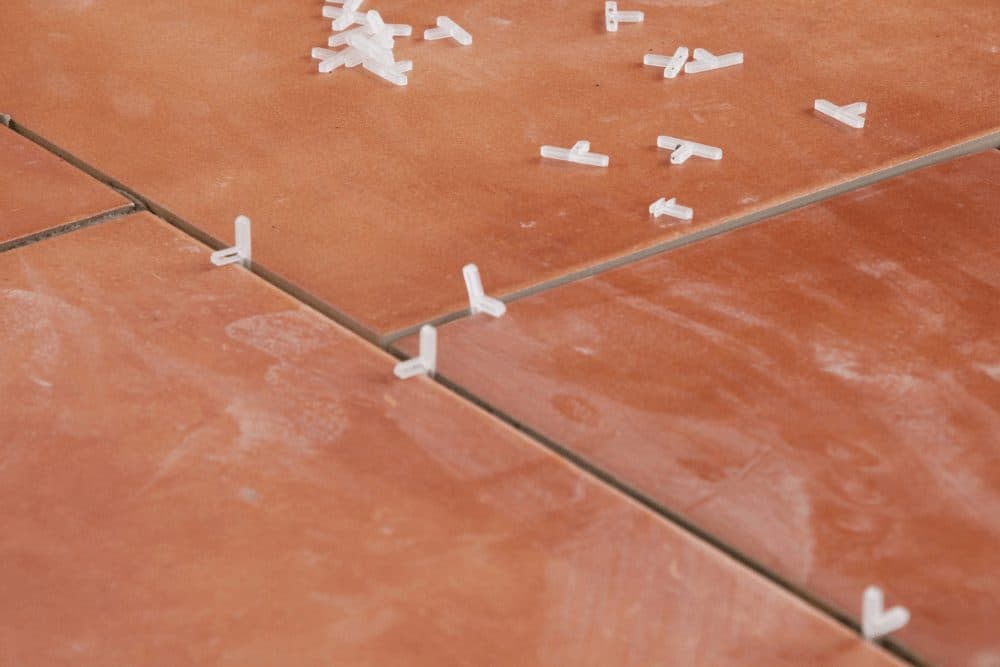
A floor needs a base that is clean, firm, dry and flat. We check the slab for hollow areas, cracks, loose screed, moisture and level, and the quote names what we repair. A floor that is uneven by a few millimetres shows as lippage, where one tile edge sits higher than its neighbour.
Levelling
Uneven floors are levelled with a screed or a self-levelling compound before tiling. The amount of levelling changes the price, which is why we measure at the inspection. Large-format tiles need a flatter base than small tiles, because a long tile bridges the dips.
Choosing a layout
The layout sets how the floor looks and how much tile is cut. We plan the layout from the room's focal line, usually the main door or the longest visible wall, so cuts fall in less visible places and the tile at the edge is not a thin sliver. Common patterns:
- Straight lay. Tiles in rows, the simplest pattern and the least waste.
- Offset or brick bond. Each row shifted, which suits long rectangular tiles.
- Diagonal. Tiles set at 45 degrees, which makes a room feel wider and wastes more tile.
- Herringbone and chevron. Decorative patterns, slower to lay and priced accordingly.
Joint widths and movement joints
Joints between tiles absorb small movement and let the floor breathe. The width depends on the tile and the edge: rectified tiles can take a narrow joint, and tiles with uneven edges need a wider one. Large floors also need movement joints at doors, walls and in long runs, because a floor that cannot move cracks. We mark them at the layout stage.
Tiles fixing on a floor is also the part of a renovation people notice for years, so the planning below is worth the time. Where the tiling is one part of a larger job, our home renovation page shows where it sits among the other trades.
Floors in different rooms
| Area | What matters | What we plan |
|---|---|---|
| Living and dining areas | Large open floor, visible lines, heavy foot traffic | A flat base, a planned layout, tiles with a matching batch |
| Bedrooms and corridors | Comfort, noise, joint lines | Straight lay, careful threshold at doors |
| Kitchens | Grease, spills, heavy items | Slip-resistant tile, sealed grout |
| Balconies and terraces | Sun, rain, drainage | Outdoor-rated tile, a slope to the drain, movement joints |
| Entrances | Sand, shoes, wear | Hard-wearing tile, a doormat zone |
| Car parks and driveways | Vehicle weight, oil | Heavy-duty tile and a suitable adhesive |
Thresholds and transitions
Where a tiled floor meets carpet, timber, another tile or a door, the height and the finish have to match. We plan the floor height with you, including doors, skirting and the existing floor beyond, so doors still open and thresholds do not trip anyone.
Wall tiling works
Wall tiling works in Dubai cover splashbacks, feature walls and full-height walls in wet rooms. Walls pose a different problem from floors: gravity. The adhesive has to hold the tile in place while it sets, and the wall has to be flat enough that tiles line up.
Splashbacks and feature walls
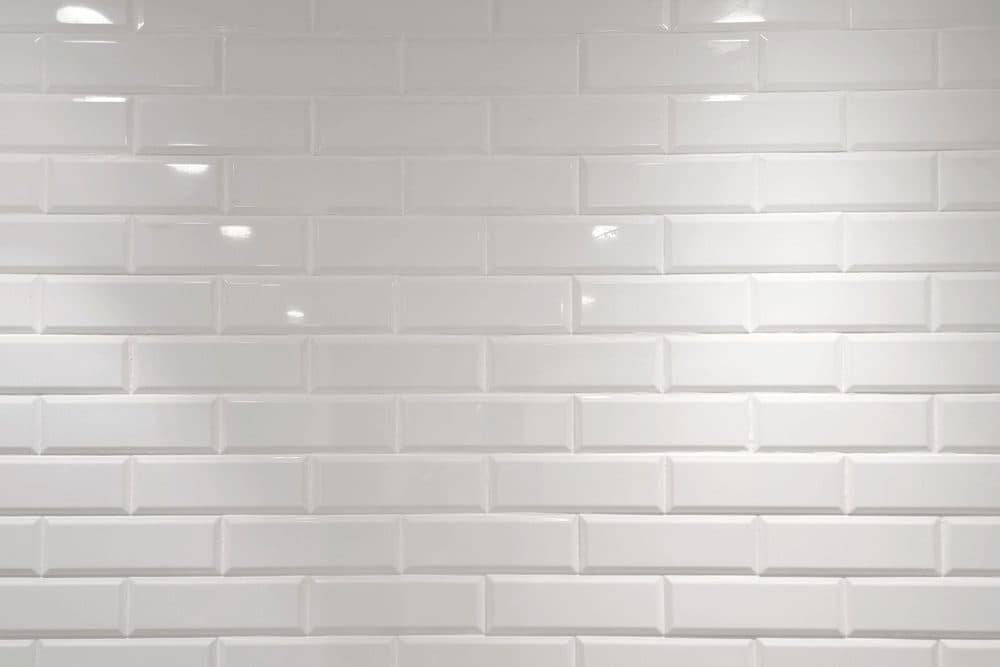
A kitchen splashback is the most common wall job. It sits behind the hob and sink, takes heat, steam and grease, and needs a surface that wipes clean. A feature wall, in a living room, a bedroom or an entrance, is a decorative job where the layout and the joint lines carry the look.
Floor and wall tiling together
If you are tiling a floor and walls in the same room, we plan the floor and wall layouts together, so the joint lines meet and cuts fall in the right places. Floor and wall tiling works are also quoted together, which is usually quicker and cheaper than two separate jobs. If you search for floor & wall tiling works in Dubai, that is the job: one plan, one team, one schedule.
Walls that are not flat
Tiling on a bumpy or out-of-plumb wall shows as uneven joints and tiles that do not sit flush. We check the wall, and if needed, we render or skim it flat before tiling. This is a common reason a small wall job needs a day of preparation.
Adhesives and joints on walls
Wall tiles are set with an adhesive suited to the tile and the wall, spread with a notched trowel so the tile has full contact. Joints are grouted once the adhesive has set, and the grout colour is agreed with you at the layout stage. Tiles in wet areas get a grout and sealant suited to moisture.
Edges, corners and trim
Corners and edges are finished with trim, mitred cuts or return tiles, depending on the look you want. We agree the finish before the job, because it decides what to order.
Fixing method by tile type
Not every tile is fixed the same way. The tile's material, size and finish decide the adhesive, the preparation and the joint. This table shows what we plan for each type.
| Tile type | What it is | How we fix it |
|---|---|---|
| Ceramic | Common, lighter, softer than porcelain | Cement-based adhesive on a clean, level base, standard joints |
| Porcelain | Dense, hard, low water absorption | A suitable adhesive for dense tile, full contact, matched joints |
| Large-format porcelain | Long or wide tiles, often rectified | A flat base, a larger trowel, adhesive on both the tile and the base (back-buttering), narrow even joints |
| Natural stone (marble, granite, travertine) | Natural, varied, can stain or absorb water | A suitable adhesive for stone, a sealer, careful handling, matching veining |
| Mosaic | Small tiles on a mesh sheet or loose | A fine adhesive, narrow joints, careful alignment |
| Outdoor and anti-slip | Textured surface, rated for wet conditions | An adhesive suited to outdoor conditions, a slope to drainage, movement joints |
Large-format tiles
Large tiles look clean with fewer joints, and they are less forgiving. A long tile shows any dip in the floor, so the base has to be flatter. Adhesive is applied to the base and the back of the tile, so there are no voids that crack under load. They are also heavy, and wall installation needs more care.
Natural stone
Natural stone needs more care at every stage. Light-coloured stone can show the adhesive colour through the tile, so the adhesive colour is chosen with that in mind. Stone is sealed before and after grouting where the stone calls for it, and some stones need special adhesives. Stone also needs protecting while the job is under way, because it marks. If your stone floor will later need polishing, our marble polishing team handles that.
Mosaic
Mosaic tiles come on sheets or as loose pieces, and they are laid in small sections. They need an even base, a thin adhesive bed and patient alignment. Joint lines are narrow, and the spacing between sheets has to match the spacing within them.
Outdoor tiles
Outdoor tiles take sun, rain, sand and temperature swings. The floor has to fall to a drain, the tile has to be rated for outdoor and wet use, and movement joints are essential. Tiles on a balcony slab above another unit also depend on the waterproofing under them.
Follow the manufacturer's instructions
Adhesive, grout and sealer manufacturers publish instructions for their products: mixing, open time, joint width, curing and sealing. We follow them, and the quote names the products.
Preparation and waterproofing
Good tile work is mostly preparation. Preparation is the part the tile does not show, and the part that decides how long the floor lasts. A flawless tile on a poor base fails, and a plain tile on a good base lasts.
The base
| Check | What we look for | What we do if it fails |
|---|---|---|
| Soundness | Loose or crumbling screed, hollow areas, old tile adhesive | Remove and repair |
| Cleanliness | Dust, oil, paint, curing compound, old adhesive | Clean or grind |
| Level and flatness | Dips, humps, slopes in the wrong direction | Level with screed or self-levelling compound |
| Cracks | Hairline and structural | Repair; a growing crack is flagged before we tile |
| Moisture | Damp slab, rising damp, leaks | Treat the source and let the slab dry |
| Falls | Slope to drains in wet areas and balconies | Correct the fall before tiling |
Moisture
Moisture is the hidden cause of tile failure. A slab that is still damp, a leak below, or water getting in from outside lifts tiles and stains grout. We check moisture at the inspection, and if we find a leak or damp, the quote lists the repair first. Tiles laid over a damp base fail, whatever the adhesive.
Primers and bonding agents
Smooth, dense or very absorbent bases need a primer or bonding coat so the adhesive grips. The product depends on the base, and we name it in the quote.
Waterproofing wet areas
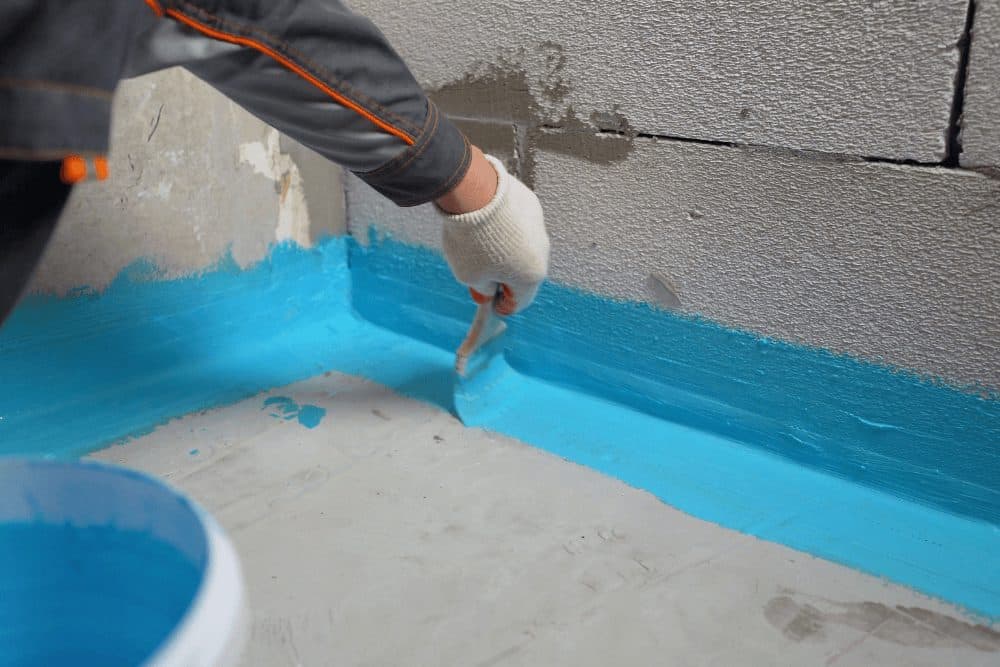
Bathrooms, showers, kitchens with a floor drain, balconies and terraces need a waterproofing layer under the tile. Without it, water passes through the grout and the adhesive and reaches the slab. We apply a waterproofing membrane before tiling and let it cure before we start, and we carry out waterproofing as its own job when you need it.
Expansion and movement joints
A floor expands and contracts with temperature, and a building moves over time. Movement joints, filled with flexible sealant, let the tile surface move without cracking. They are placed at doors, at changes of direction, along large runs and where the tile meets a wall.
How a tile job runs, with timings
A tile job runs in the same order each time. The timing depends on the area, the tile, the state of the base and the layout.
Step 1: Inspection. We walk the area, check the base, measure the floor or wall, note moisture and repairs and agree the tile, the layout and the finish. The inspection fee is AED 100, and a written quote follows.
Step 2: Protection and removal. Floors, furniture and fittings are covered. Old tiles, if any, are removed and the debris is cleared.
Step 3: Base preparation. The base is repaired, cleaned, primed and levelled. Waterproofing goes on wet areas and cures.
Step 4: Layout. We dry-lay the tiles to plan the pattern, joint lines and cuts, and mark movement joints.
Step 5: Fixing. Tiles are set in adhesive with a notched trowel, checked for level, flatness and joint spacing as the work proceeds.
Step 6: Grouting and finishing. Once the adhesive has set, joints are grouted, movement joints are sealed and the surface is cleaned.
Step 7: Snagging and handover. We walk the area with you, tap for hollow tiles, check levels and joints, and correct what we find. We give the product's guidance on when the floor can take foot traffic and furniture. The one-year workmanship warranty starts at handover.
Typical durations
These are typical durations for normal conditions, with the base ready.
| Job | Typical duration |
|---|---|
| Small floor or a splashback | 1–2 days |
| One room floor | 2–3 days |
| A 2-bedroom apartment floor | 4–7 days |
| A 3-bedroom apartment floor | 6–9 days |
| A villa floor | 2–3 weeks |
| Removal of old tiles | Add 1–3 days depending on the area |
| Waterproofing | Add the membrane's cure time |
Adhesive and grout need time to set and cure before use. We give the manufacturer's times and plan the job so the floor takes foot traffic and furniture only when it is ready.
What changes the timing
- Tile size and pattern. Diagonal, herringbone and mosaic take longer than a straight lay.
- The state of the base. Levelling, repairs and moisture treatment add days.
- Removal. Breaking out old tiles adds time and dust.
- Waterproofing. The membrane has to cure before tiling.
- Access. Upper floors, narrow lifts and restricted hours slow the delivery of tile and materials.
- Building rules. Permits and working hours limit what can be done each day.
We follow the working-hour rules of your building or community. Where weekends or evenings are allowed and approved, we use them to shorten the schedule.
Why tiles fail and how to prevent it
Most failed tile jobs fail for a short list of reasons, and nearly all trace back to the base, the adhesive or the layout. Knowing them lets you ask the right questions.
| Problem | What you see | Usual cause | How to prevent it |
|---|---|---|---|
| Hollow tiles | A drummy sound when tapped | Gaps in the adhesive bed, a poor trowel, no back-buttering on large tiles | Full contact, correct trowel, tap-test before grouting |
| Tiles lifting | Tiles pop up or rock | Moisture, a weak base, wrong adhesive, no movement joints | Dry slab, sound base, matched adhesive, joints |
| Cracked tiles | Cracks through the tile | A hollow bed, a point load, base movement | Full contact, a stable base |
| Cracked grout | Fine cracks in joints | Movement, wrong grout, joints too narrow or too wide | Movement joints, matched grout, correct joint width |
| Lippage | One edge higher than its neighbour | An uneven base, a warped tile, poor setting | A flat base, levelling clips, checking as we go |
| Stained or discoloured grout | Dark or white patches | Moisture, efflorescence, poor cleaning | Waterproofing, correct cleaning at the end |
| Staining of stone | Spots or shadows | Adhesive colour, unsealed stone, spills | A suitable adhesive, sealing |
| Uneven joints | Wandering, wedge-shaped lines | Poor layout, out-of-square walls | A dry layout, a reference line |
The tap test
Tapping a laid tile with a knuckle or the handle of a trowel tells you whether the adhesive is under it all the way. A solid sound is good, and a hollow sound means a void. We tap before grouting, while the tile can still be lifted and reset.
Efflorescence
White salty deposits on grout or on a tile edge are efflorescence, left by moisture moving through the base and evaporating. They mean the area is getting wet from below or behind, and they return until the moisture is stopped.
What a warranty covers
Our one-year workmanship warranty covers faults in our workmanship, such as hollow or loose tiles caused by installation. It does not cover damage from impact, a leak that starts above or below the tile, or movement in the building. We give the written terms on request.
Removing old tiles and repairing damaged ones
Many tiling jobs start with tiles that are already there. Taking them out properly is part of laying the new ones.
Removing old tiles
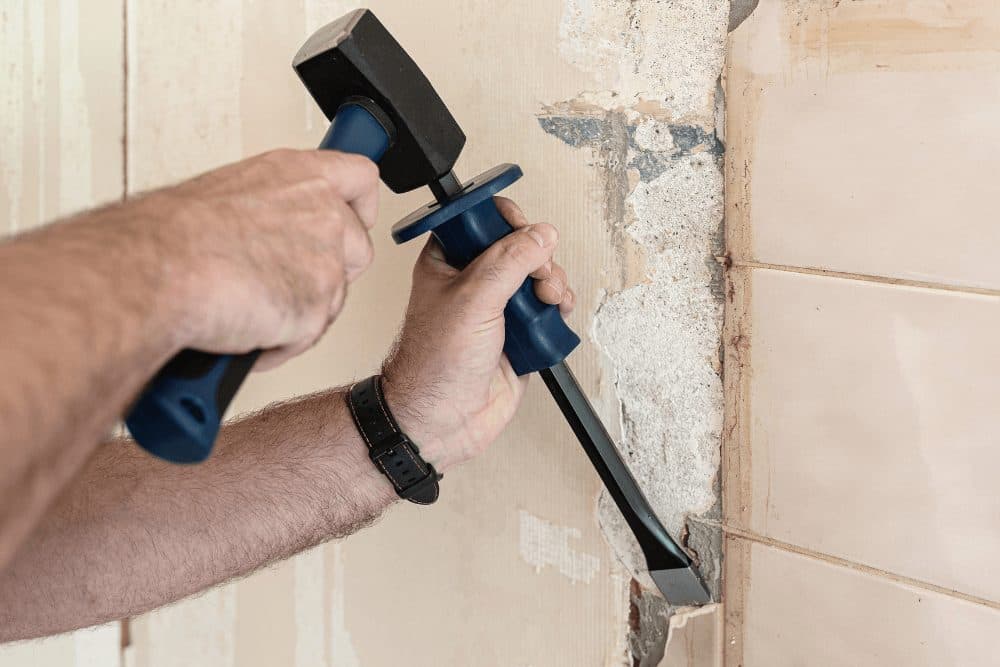
Old tiles are broken out and lifted, and the old adhesive is chipped or ground off. The work is noisy, dusty and heavy. We protect the floor and surrounding areas, seal doorways, remove the debris and clean up daily.
What is under the old tile
Old tiles hide the condition of the base. Once they are lifted, we may find hollow screed, cracks, damp or a poor fall. We tell you what we find and price the repair before we continue.
Overlaying on existing tiles
Sometimes new tile can go over old, if the old is sound, flat and firmly bonded. It raises the floor height and adds weight, and it can hide problems below. We say at the inspection whether it is suitable, and we recommend removal when it is not.
Replacing a few tiles
If a few tiles are cracked or hollow, we cut out and replace them, and we regrout the area. Matching an old tile is the hard part: the colour, the finish and the batch may no longer be available. If you kept spare tiles from the original job, give them to us. If not, we show you the closest match before cutting.
Regrouting and resealing
Grout darkens, cracks and wears. Regrouting renews the joints, and resealing protects stone and grout from stains and moisture. They are quicker and cheaper than retiling when the tile itself is sound.
Tile fixing rates in Dubai
Tile fixing rates in Dubai vary widely, and published figures often do not describe the same job. This section explains what a rate includes, why quotes differ and how to read one.
What a rate can mean
A rate quoted per square metre can describe very different things:
| What the rate covers | What may be missing |
|---|---|
| Labour only | Adhesive, grout, preparation, tiles |
| Labour and adhesive | Grout, levelling, waterproofing, removal |
| Supply and fix | Preparation, waterproofing, removal, VAT |
| Fully itemised | Nothing, if each line is listed |
Why one fixing rate does not fit every job
A rate per square metre means little until you know what it covers. It might be labour only, labour with adhesive, or labour with removal and preparation. It might change with the tile, because ceramic, porcelain and natural stone are not fixed at the same speed or with the same care. It might or might not include VAT. Two rates can differ simply because they describe different jobs. That is why we do not quote a single rate for every job.
How we price the work
We do not publish a per-square-metre rate for tile or marble fixing, because the price depends on the tile, the room, the layout and the condition of the base. Each job is quoted in writing after the inspection. The tile price guide shows how to budget a finished floor.
| Job | Price |
|---|---|
| Tile fixing, labour, per square metre (standard tile on a ready base) | Quoted after inspection |
| Minimum job | Quoted after inspection |
| Levelling, per square metre | Quoted after inspection |
| Waterproofing | Quoted after inspection |
| Removal of old tiles, per square metre | Quoted after inspection |
| Large-format, natural stone, mosaic and patterns | Quoted after inspection |
| Supply and fix (tiles included) | Quoted after inspection |
Prices are shown before 5% VAT. The price that applies is the written quote after the inspection, which lists labour, adhesive, grout, preparation, waterproofing, removal and any extras, so you see what each part costs.
What moves the price
- Area. More area means more tile and more time.
- Tile type. Large-format, stone and mosaic cost more to fix than standard ceramic or porcelain.
- Layout. Diagonal, herringbone and patterns add cuts and time.
- The state of the base. Levelling, repairs and moisture work add cost.
- Removal. Old tiles have to come up first, which adds labour, debris and dust control.
- Waterproofing. Showers, balconies and other wet areas need a membrane under the tile.
- Access. Upper floors and restricted hours add time.
- Supply. Who buys the tile, you or us, changes what the quote covers.
Read a tiling quote line by line
| Check | Why it matters |
|---|---|
| The area, and how it was measured | A low rate can hide a large area |
| Labour, adhesive and grout listed separately | Shows what is and is not in the rate |
| Preparation and levelling | A common extra |
| Waterproofing | Essential in wet areas |
| Removal and disposal of old tiles | Often added later as an extra |
| Tile supplied by whom | Changes the total |
| Wastage allowance | Affects how much tile you buy |
| Adhesive and grout product names | Product choice sets durability |
| VAT shown separately | Five per cent of a whole-floor quote is a real sum |
| Payment schedule | A large deposit before the first tile is laid is a warning sign |
| Warranty in writing | A spoken promise is hard to enforce |
A tiling quote far below the others may have left out waterproofing, removal or levelling. Ask each company what is included, and compare like with like.
How much tile to buy
Buying too little tile is worse than buying too much, because a second order can come from a different batch with a slightly different colour. A little planning avoids it.
Measure the area
Multiply length by width for each area, and add them. For walls, measure the height and width of each section and subtract large openings. One square metre is about 10.76 square feet, which helps when a tile box states its coverage in the other unit.
Add wastage
Cutting, breakage and pattern matching use tile. Allow 5 to 10 per cent extra as a rule. We advise about 10 per cent for most rooms, and more for diagonal and herringbone layouts, small rooms with many cuts and natural stone with matching veining. We confirm the number at the inspection, once we know the layout.
Buy from one batch
Tiles from different production batches can differ in shade and size. Check that all boxes carry the same batch number, and open a few boxes to compare before the work starts.
Keep spare tiles
Keep a few unopened tiles after the job, for repairs years later. We advise one or two boxes for a large floor, depending on the tile.
Check the delivery
Check the delivery for the number of boxes, the batch, the finish and breakage before signing. We check it with you if you wish, and we report any problems to the supplier.
Tile fixer, contractor or company?
People search for a tile fixer, a tiling contractor or a tile fixing company in Dubai and mean the same thing. The three are not the same, and the difference affects the risk you take on.
| Tile fixer | Tiling contractor | Tile fixing company | |
|---|---|---|---|
| Who they are | An individual tradesperson | A small business with a team | A registered business with staff, equipment and procedures |
| Usually offers | Fixing tiles | Fixing, often preparation and finishing | Preparation, waterproofing, fixing, finishing and snagging |
| Paperwork | Often none | Varies | Trade licence, written quote, invoice, warranty |
| Accountability | Personal | Business | Business, with a record |
| Suits | A small repair | A single room | A full floor, a renovation or a commercial job |
How to choose a tile fixing company in Dubai
Use this checklist when you compare tile fixing contractors in Dubai, including us.
- Check the company. The trade licence should show the same name as the quote.
- Ask who will do the fixing. Some companies take the booking and hand the job to subcontractors. Ask whether the installers are employees, and meet the supervisor.
- Ask how they will prepare the base. The answer should cover levelling, moisture and waterproofing.
- Ask which adhesive and grout they use. The product names should be in the quote.
- Ask how they handle large-format and stone. A good installer talks about back-buttering, flatness and sealing.
- Ask about the layout. A dry layout before fixing shows care.
- Ask about movement joints. A floor with none is a warning sign.
- Ask for the rate breakdown. Labour, adhesive, grout, preparation, waterproofing and removal should be separate lines.
- Check the payment schedule. Fair terms are a small deposit, stage payments as the work moves on and a final payment after the snagging walk. Full payment up front is not.
- Ask about the warranty. Ours is a one-year workmanship warranty, with the terms in writing on request.
- Ask for past work you can see. A floor you can visit is more useful than a photo.
If you are shortlisting, send each company the same photos, the same area and the same tile, so you compare like with like.
Tile fixing Dubai: where we work
We offer tile fixing Dubai-wide, in every community and building, as floor tiling Dubai owners book for new homes and as tiles installation services Dubai landlords book for renovations. We work across Dubai, including Dubai Marina, JLT, Downtown Dubai, Business Bay, Jumeirah Village Circle, Al Barsha, Dubai Hills, Arabian Ranches, Damac Hills, Mirdif, Dubai Silicon Oasis, Dubai Sports City, Motor City, Al Quoz, Deira, Bur Dubai and Dubai South. If your area is not listed, we cover it too.
Many buildings and communities have rules on working hours, lift booking, deliveries and noise, and tiling is noisy and heavy. For tiles installation Dubai-wide or tiling services in Dubai for a single building, tell us the building when you contact us, and we plan around its rules. We protect floors and lifts, seal doorways against dust and clean up daily.
How to get a tile fixing quote in Dubai
Tiling quotes depend on the base and the tile, so message us on WhatsApp at +971 55 209 9785 with:
- Where the property is: the building or community, and whether it is occupied or empty.
- The job: floor, wall, bathroom, kitchen, outdoor, repair or removal.
- The size of the area, in square metres or square feet.
- The tile you have chosen: type, size, finish, and whether you supply it.
- Photos of the area, including cracks, damp and the existing tiles.
- Your preferred dates, and any deadline such as a move-in.
- Building rules: working hours, lift booking, permit requirements.
We reply with what the photos let us price and what needs inspection. The inspection costs AED 100. The written quote that follows lists the work, the products, the price before VAT, the schedule and the warranty terms.
Keep reading
Frequently asked questions about tile fixing in Dubai
How much does tile fixing cost in Dubai?
The price follows the area, the tile, the layout, the state of the base and what is included. Published rates vary widely because they do not cover the same scope. We quote after inspection, and the written quote lists labour, adhesive, grout, preparation, waterproofing and removal separately. Prices are before 5% VAT.
How long does it take to tile a room or an apartment?
A small floor or a splashback takes one to two days, a room floor two to three days and a two-bedroom apartment floor four to seven days. Removal and waterproofing add time. The quote states the schedule.
Do you supply the tiles?
Yes, if you want us to. A supply-and-fix quote covers the tile and the fixing together, and we help you choose and order. If you buy the tile yourself, we check the delivery for quantity, breakage and batch before we start.
Can you tile over my existing tiles?
Sometimes. The old tiles have to be sound, flat and firmly bonded, and the new layer raises the floor and adds weight. At the inspection we say whether overlaying suits your floor, and if it does not, we recommend taking the old tiles out.
Do you remove old tiles?
Yes. We break them out, clear the debris, remove old adhesive and level the base. We protect the surrounding areas and clean up daily.
Do you waterproof before tiling?
Yes, in wet areas such as showers, bathroom floors, kitchens with drains, balconies and terraces. We apply a membrane and let it cure before tiling.
Can you fix large-format porcelain and natural stone?
Yes. Large-format tiles need a flat base, adhesive on both the tile and the base, and narrow even joints. Natural stone needs a suitable adhesive, sealing and careful handling. We name the products in the quote.
Do you tile outdoors?
Yes. We tile balconies, terraces, driveways and pool surrounds with outdoor-rated tile, a fall to drainage and movement joints.
How much extra tile should I buy?
We advise about 10 per cent for most rooms, and more for diagonal and herringbone layouts or stone with matching veining. Buy from one batch, and keep a few spare tiles for future repairs.
Do you work weekends and evenings?
Where your building or community allows and approves it, yes. Tiling is noisy and heavy work, so some buildings fix their hours, and we follow them. Tell us your deadline when you ask for the quote.
Where this fits in a whole job, from choosing the tile to handover, is in our guide to tiles in the UAE.
Get a quote for tiles installation
Tell us what you need, or send photos on WhatsApp. A site inspection costs AED 100, and you get a written quote after the visit.
- +971 55 209 9785
- info@dubairepairpro.com