Specialty Painting in Dubai: Murals, Doors, Furniture, Fences and Quick Jobs
Dubai Repair Pro is a Dubai LLC with its own team of painters. This page covers the jobs that sit beside walls and ceilings: a mural on a feature wall, the doors in a home, wardrobes and tables, a garden fence and the small jobs that do not need a full repaint.
Last updated: 15 October 2026
On this page
- Specialty painting in Dubai: what we do beyond walls
- Mural painting in Dubai
- Choosing a mural: size, style and where it goes
- Door painting in Dubai
- Indoor furniture painting in Dubai
- Garden fence painting in Dubai
- On-the-spot painting in Dubai
- Brush, roller or spray
- How specialty painting is priced
- Choosing a painter or artist for specialty work
- Where we take specialty jobs
- How a specialty painting quote works
- Frequently asked questions about specialty painting in Dubai
These jobs are not harder than a wall, but they are different. A door is handled all day, a piece of furniture has a surface that paint does not want to stick to, a fence sits in the sun, and a mural is judged by a person standing two metres from it. Each one has a preparation step that decides the result and a finish that suits the use. This page explains both for each job, how to choose between brush, roller and spray, how these jobs are priced and the questions to ask any painter before you hire.
For ordinary walls and ceilings, see our guides to interior painting and wall painting. To start a specialty job now, send photos on WhatsApp at +971 55 209 9785. A site inspection costs AED 100.
Specialty painting in Dubai: what we do beyond walls
The table lists the jobs on this page and what each involves.
| Job | What it involves | Where it is covered below |
|---|---|---|
| Murals and feature art | Design, wall preparation, hand, stencil or spray painting, sealing | Mural painting services in Dubai |
| Interior and entrance doors | Sanding, priming, brushed, rolled or sprayed coats | Door painting services in Dubai |
| Indoor furniture and cupboards | Cleaning, keying the surface, special primer, durable finish | Indoor furniture painting services in Dubai |
| Garden fences and gates | Cleaning, rust or rot treatment, primer, weather-resistant paint or stain | Garden fence painting services in Dubai |
| Small jobs and touch-ups | Quick visit, targeted repair and repaint | On-the-spot painting services in Dubai |
All of this work is done by the same employed crew that paints our walls. We do not subcontract the painting. The paint comes from the main brands sold in Dubai, including Jotun, National Paints and Dulux, or a brand you prefer, chosen to suit the surface.
Mural painting in Dubai
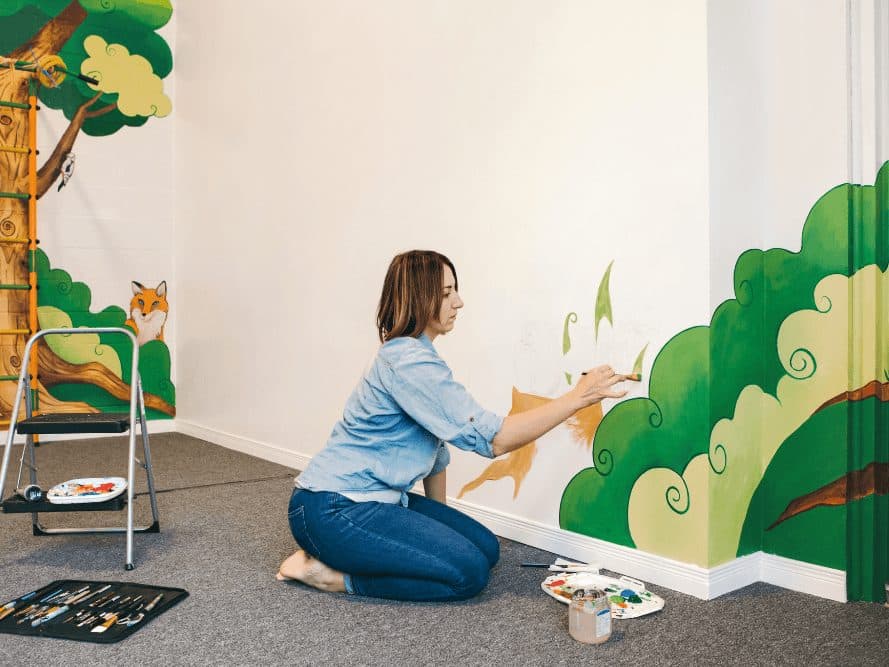
A mural turns one wall into the focus of a room: a child's bedroom with a jungle, a living room with a skyline, a café wall with a pattern, an entrance with a large graphic. Mural work covers everything from a simple geometric feature wall to a hand-painted scene across a whole wall.
Four things decide the result: the design, the wall, the paint and the sealing. Missing any one of them is how a mural ends up looking good for a month and tired after a year.
Step 1: the design
A mural starts with a brief. You tell us the room, the wall size, the subject, the colours you like and the mood. We turn that into a sketch or a colour layout, and you approve it before any paint goes on the wall.
The design stage is where most of the avoidable mistakes are caught. A good brief includes:
- Photos of the wall, including the windows, the light fittings, the sockets and any furniture that will stand against it.
- The viewing distance. A mural seen from across a room needs bold shapes. A mural seen from a sofa one metre away can carry fine detail.
- The colours already in the room, meaning floor, furniture and the neighbouring walls.
- Any images you like, as a guide to style only. We paint an original design, not a copy of someone else's artwork or a brand's characters.
Murals that include logos, brand names or characters belong to someone else. For a business premises, we paint your own logo and your own artwork. We do not reproduce a protected character or another company's mark.
Step 2: the wall
A mural is only as good as the surface under it. We check the wall for cracks, damp, peeling paint and texture, and repair them before painting. Plaster that is still damp, or a wall that has had water behind it, is not painted until the cause is fixed.
Then the wall receives a base coat. The base coat gives the artwork an even, correctly coloured background. A white or pale base is the usual choice. A dark base can work for a design that uses light colours on top, though it needs more coats.
Step 3: transferring and painting the design
There are three common ways to put a design on the wall. Each suits different designs.
| Method | How it works | Best for | Limits |
|---|---|---|---|
| Hand-painted | The design is drawn on the wall, then painted with brushes and small rollers | Scenes, portraits, detailed art, soft colour blends | Slower, so it takes more days |
| Stencil and roller | Cut stencils are fixed to the wall and painted in sections | Patterns, repeats, borders, lettering | Less suited to fine shading |
| Spray | The paint is applied with a spray gun, often with masking | Large flat colour areas, gradients, bold graphics | Needs thorough masking and ventilation |
Many murals mix methods. A skyline might use spray for the sky gradient, masking for the building edges and brushes for the detail. We choose the method with you at the design stage, since the method affects both the look and the schedule.
Step 4: sealing
A mural on an interior wall that people touch, or that sits in a sunny room, needs protection. A clear protective coat over the finished artwork makes it easier to clean and reduces wear. For a sun-exposed wall, a clear coat with UV protection slows fading.
Fading is the main long-term risk in Dubai. Direct sun on a coloured wall changes the colour over time, and strong reds, yellows and deep blues fade faster than neutrals. If the wall gets direct sun for hours, tell us. We choose the paint and the clear coat to suit, and we may suggest keeping the strongest colours for areas that get less light.
Interior and exterior murals
Interior murals use interior paint and a sealer, and they are the more common job. Exterior murals need exterior-grade paint, weather-resistant sealing and access equipment, and in a community or a building they need permission before the work starts. Check with your landlord, your building management or your community office before you plan an exterior or balcony wall mural. The approval is the building's decision, and we plan the dates around it.
Wall art painting Dubai clients commission covers murals, hand-painted designs and feature artwork. Our wall art painting service in Dubai starts with the design and the wall, and the sealed result can be repainted when you move. If you are looking for artistic wall painting, custom wall painting or decorative wall painting in Dubai, ask to see the painter's earlier work, because style and finish are personal. The best decorative wall painting in Dubai is judged in close-up photos of edges and colour blends.
Choosing a mural: size, style and where it goes
A few decisions shape the quote and the result.
Size and position
A mural on one wall is the usual starting point. A full-room mural is possible, though it takes longer and needs more planning. A feature wall behind a bed or a sofa works well because people face it. A wall that is hidden by wardrobes and furniture is wasted.
Style
The style should suit how long you plan to live with it. A neutral abstract or a soft nature scene lasts years. A cartoon mural in a young child's room may be outgrown in a few. If you are a tenant, ask your landlord first and plan to paint over it when you leave.
Colour and light
Test colours on the wall before the full design. Mural colours look different in a sunny room and an evening-lit room. We paint a small sample of the main colours on the wall, in the same way we do for a normal repaint.
Tenants and landlords
A mural on a rented wall usually needs the landlord's permission, and the tenancy contract may require the wall returned to its original colour. We cover that with move-out repainting; see our move-out painting guide.
Commercial murals
Cafés, shops, gyms, offices and schools use murals to set a brand or a mood. Commercial jobs work to a fixed opening date and often need evening or weekend work. See our commercial painting guide for scheduling.
When a mural is not the right answer
If the wall is damaged, damp or heavily textured, repair it first. If you want to change the picture often, consider a framed print or a removable wallpaper instead. If the wall gets very strong sun, think about whether the colours you want will last.
Door painting in Dubai
A painted door is judged close up. Brush marks, drips, a soft edge or a sticky surface are all obvious, and a door is touched every day. The difference between a door that looks new for years and one that chips in months is almost entirely preparation.
Door painting covers interior doors, entrance doors, door frames and architraves. Here is how we approach each.
Interior doors
Interior doors are usually wood, veneer, MDF or foil-wrapped board. Each takes paint differently.
| Door material | Preparation | Primer |
|---|---|---|
| Solid wood, previously painted | Clean, sand to remove the gloss, fill dents | Often only spot priming |
| Solid wood, varnished | Sand through the varnish so the surface is dull | A bonding primer |
| Veneer | Clean, light sanding, fill chips | A bonding primer |
| MDF | Clean, light sanding, seal the edges | A primer made for MDF |
| Foil-wrapped or laminate | Degrease, key the surface | A primer made for slick surfaces |
Steps for a door
- Remove or mask the hardware. Handles, locks and hinges are removed where possible, since masking leaves a rough edge.
- Clean. Fingerprints, grease and polish stop paint from bonding.
- Sand. The old finish is sanded until the shine is gone. Dents and chips are filled and sanded flush.
- Prime. Bare wood, a new filler and slick surfaces all need the right primer.
- Paint in thin coats. Two thin coats look better than one thick coat. Thick coats sag, run and take longer to harden.
- Sand lightly between coats with fine paper to remove dust nibs.
- Let the door cure. A door that is shut too early can stick to the frame. We leave it open while it hardens and tell you how long to be careful.
Order of painting a door
On a panelled door, we paint the panels first, then the horizontal rails, then the vertical stiles, so the wet edges stay clear of the finished areas. On a flat door, we work from the top in sections.
Entrance doors
An entrance door faces the weather, the sun and the heat of a corridor or a villa porch. Direct sun makes dark colours hot and can cause paint to blister if the door was not prepared properly. A front door also takes more knocks and cleaning than an interior one.
We use a durable, washable finish suited to the door's material. A steel or metal door needs rust treatment and a metal primer before any colour. A wooden entrance door that is exposed to the sun needs an exterior-grade finish. If your building controls the colour of the doors facing the corridor, check before you choose; many towers and communities do.
Frames, architraves and skirting
A door painted in a fresh colour inside a tired frame looks worse than before. We recommend painting the frame and the architrave with the door. They are quoted as separate lines, so you can choose.
Brush, roller or spray for doors
A brush and a fine foam roller give a good finish on site for most interior doors. Spraying gives the smoothest result and works best when the door is removed and sprayed away from the living area, or when the room is fully masked and ventilated. We describe the options below.
Indoor furniture painting in Dubai
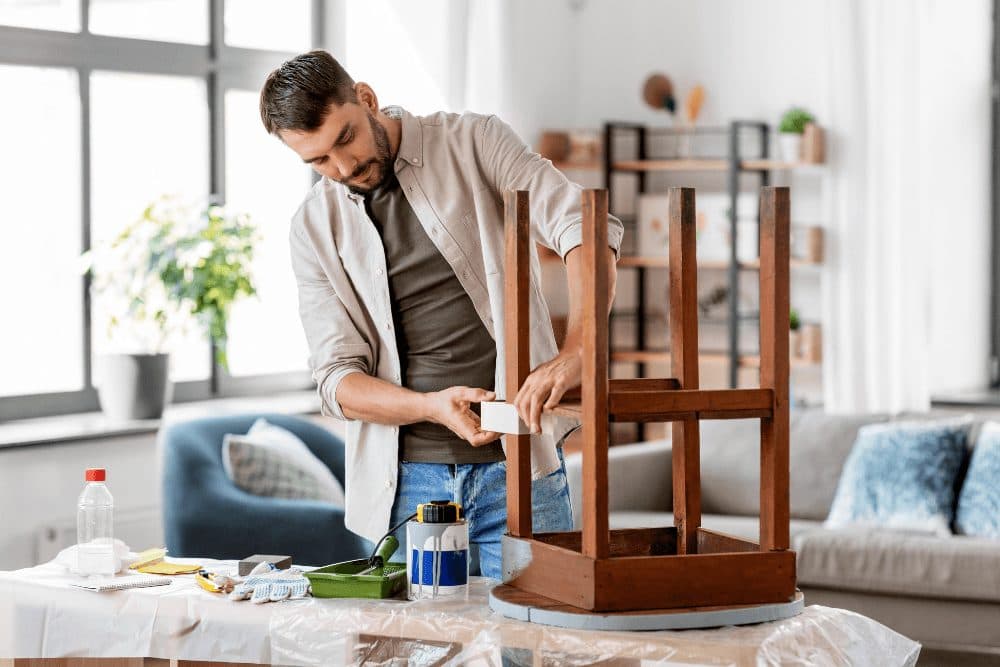
Painting furniture can refresh a piece that is sound but dated: a wardrobe, a kitchen cabinet, a bedside table, a dining table, a sideboard. Furniture painting starts with an honest question: is this piece worth painting?
What paints well
- Solid wood that is sound, clean and sanded.
- MDF and veneer in good condition, with the right primer.
- Built-in wardrobes and cupboards that are sturdy and only dated in colour.
- Wooden chairs and tables with sound joints.
- Metal frames, after removing rust.
What does not paint well
- Peeling or bubbling laminate. Paint will not hold a surface that is already lifting. The laminate should be repaired or replaced first.
- Swollen or water-damaged chipboard. Paint hides the damage but does not stop it.
- Leather, fabric and soft plastics. These need specialist products.
- Valuable antiques. Painting can reduce their value. We would send you to a restorer.
- Surfaces with a very glossy, oily finish that we cannot degrease or key properly.
If we think a piece will not hold paint, we say so at the visit. A painter who agrees to paint anything is a painter who has not looked at it.
Steps for painting furniture
- Clean and degrease. Polish, wax, cooking grease and hand oils are the main enemy of paint on furniture.
- Remove hardware. Handles, hinges and knobs come off. If a piece cannot be moved, the hardware is masked and the edges are cut with care.
- Repair. Chips, dents and open joints are filled.
- Sand or key the surface. The aim is a dull, evenly scratched surface.
- Prime. A primer chosen for the surface: one for bare wood, one for MDF, one for slick surfaces, and a stain-blocking primer over wood that bleeds.
- Paint in thin coats, with light sanding between them.
- Cure. Furniture is used, so the finish has to harden before it gets heavy use. We tell you how long to wait before putting items on a painted surface.
Choosing the finish
Furniture takes wear. A satin or semi-gloss finish is easier to wipe than matt and holds up better on table tops, cupboard doors and drawer fronts. A matt finish looks softer and shows marks more. For a table top, ask for a hard-wearing finish and avoid placing hot items directly on it.
Colour and style
Dark furniture painted pale needs a good primer to stop the old colour showing through. A pale piece painted dark needs fewer coats. Matching a new colour to the walls is simple if we are painting both: the sample patches go on the wall and a test board for the furniture.
Wardrobes and built-in cupboards
A built-in wardrobe that matches the walls makes a small bedroom feel larger. A wardrobe in a contrasting colour can become a feature. Built-in units are painted in place, with the interior covered and the hardware removed. The quote shows the number of doors and drawer fronts, since each one is a separate surface.
On site or in a workshop
We paint on site. Large pieces are cleaned, sanded and painted in the room with the floor and nearby items covered. If a job needs spraying, tell us when you ask for the quote. We cover how we handle spraying below.
Garden fence painting in Dubai
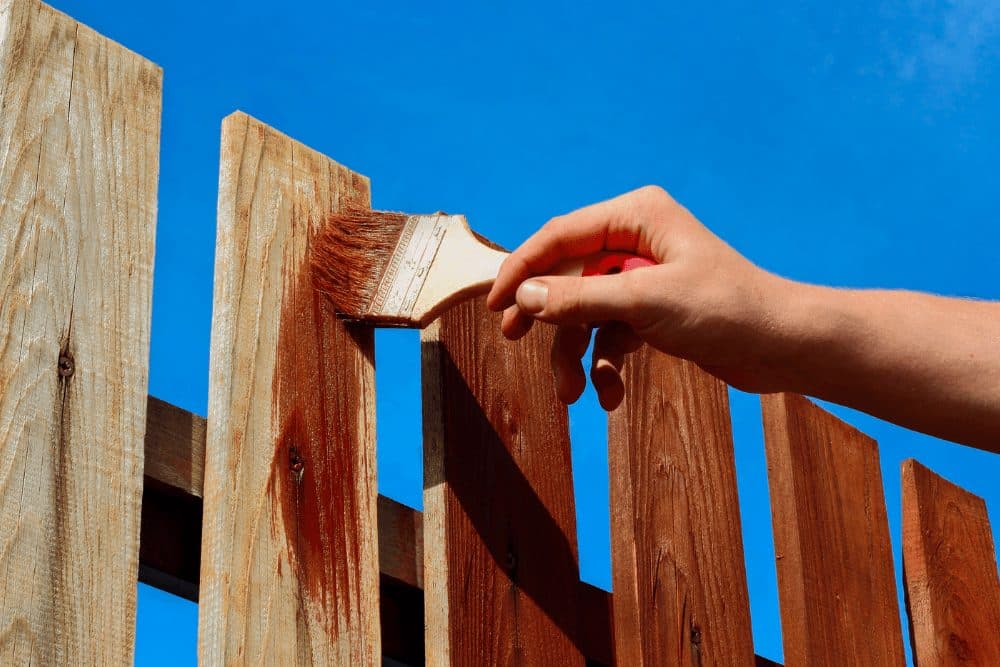
A garden fence, a boundary gate or a pergola sits outside all day. The sun is strong for much of the year, rain is rare but heavy when it comes, and dust and sand settle on every surface. Fence painting therefore concentrate on prep and on a product made for the outdoors.
What the fence is made of
| Material | Typical problem | What we do |
|---|---|---|
| Wood | Dried, faded or cracked surface; peeling old paint | Clean, sand, fill, treat, then stain, oil or paint with an exterior product |
| Metal (steel, iron) | Rust, flaking paint | Remove loose rust, apply a rust-inhibiting primer, paint with a metal finish |
| Aluminium | Chalky, dull paint | Clean, key the surface, use an aluminium-suitable primer |
| Masonry or block wall | Dust, algae, flaking paint, hairline cracks | Wash, repair cracks, apply an exterior masonry coat |
| Composite and PVC | Faded colour | Clean and use a product made for the material, or leave unpainted |
Preparing the fence
- Wash. Dust, sand, salt and algae are removed with water, a brush or a washer, and the fence is left to dry.
- Remove what is loose. Flaking paint, loose rust and soft, rotten wood are scraped or cut back.
- Repair. Gaps and cracks are filled with a product suited to outdoor use. Rotten sections of wood are replaced, since paint cannot rescue them.
- Sand and treat. Wood is sanded and treated. Metal gets rust treatment.
- Prime. The primer must suit the material.
- Paint or stain, in the number of coats the product requires.
Wood: stain, oil or paint
A paint forms a film on the surface and hides the grain. A stain soaks in and shows the grain. An oil feeds the wood. Paint lasts well where the preparation is thorough and the wood is sound. A stain is easier to refresh, since you can recoat without stripping. For a fence in direct sun, an exterior product with UV protection is the right category. We recommend a product at the quote stage, based on what is there now.
Working with the sun
Paint applied to a very hot surface dries too fast, which can leave marks and weak adhesion. We plan outdoor work for the cooler hours and avoid painting a surface in full midday sun where we can. The schedule moves with the weather, and we tell you if a day is lost.
Boundary walls and shared fences
If the fence is shared with a neighbour, or if the community controls external colours, check before you choose. Many villa communities set approved colours for boundary walls and gates. Our villa painting guide covers the exterior, and the same approvals apply here. For a complete exterior job, see the notes on exterior house painting Dubai on that page.
Gates, railings and pergolas
Gates and railings are painted in the same way as fences, with extra attention to the hinges, the latches and the joints, where rust and peeling start. Pergolas are wood or aluminium, and we treat them as we would a fence of the same material.
On-the-spot painting in Dubai
Not every job needs a full repaint. A scuffed wall, a mark where a picture hung, a patch of damp that has been fixed, a new socket plate, a door that was damaged in a move: these are touch-up jobs. Quick-visit painting covers these small jobs, done quickly after a short visit.
People who search for onspot painting services Dubai usually want a small fix done quickly, not a full repaint, and that is how we treat these jobs.
What counts as an on-the-spot job
- Touch-ups after plumbing, electrical or AC work.
- Patches after a repair, such as a filled hole or a removed shelf.
- A single scuffed or marked wall.
- A single door, a skirting board or a window frame.
- A pre-inspection touch-up before a landlord or agent visits.
- A quick tidy before handing a unit back.
How we handle them
- You send photos on WhatsApp at +971 55 209 9785, with the location and what you need.
- We tell you whether the job can be done as a touch-up or whether it needs a full wall. A touch-up on an old wall rarely matches by itself; paint fades, and a new patch may show.
- We visit, match the colour as closely as we can, prepare the patch properly, and paint it.
- We blend the edges so the patch does not show as a square. In many cases the whole wall is painted from corner to corner, since a single wall looks better than a patch.
Colour matching
Matching an existing colour is the hard part of a touch-up. A paint shop can scan the colour from a chip of the wall. The scan is close, not exact, and the old paint has aged, so a patch can look different even when the code is right. For that reason, a single wall painted fully often looks better than a patched spot. We advise on the best option at the visit.
Minimum charge
A small job still needs the same arrival, preparation and clean-up, so a minimum charge applies, starting from AED 270 before VAT. We will tell you whether your job is a minimum job.
When a quick job is not enough
If the marks are signs of damp, the patch will return. If a patch is the third on the same wall, the wall needs a repaint. If your landlord expects a full repaint, a touch-up will not satisfy a contract. We say so.
We also remove old paint and then repaint. Paint removal and repainting cover stripping flaking paint from walls, doors and metal before a new coat. Kids room painting services in Dubai, including murals and low-odour paint, are available too.
Brush, roller or spray
The method is chosen to suit the surface and the finish. Here is how they compare.
| Method | Strengths | Limits | Used for |
|---|---|---|---|
| Brush | Control, good for edges, corners and detail | Leaves brush marks if the paint is not levelled | Trim, frames, small areas, detail on murals |
| Roller | Fast on flat areas, even texture | Not suited to detail | Walls, ceilings, flat doors |
| Spray | Smoothest finish, quick on large or complex shapes | Needs masking, ventilation and skill | Doors, cupboards, railings, some murals |
What spraying requires
Spraying produces a very smooth finish, but the fine mist travels. Everything nearby needs covering, the room needs ventilation, and the person spraying needs to wear proper protection. In a home with people, children or pets present, spraying is best done when the area can be sealed off and left to clear. In a tower apartment, building rules and neighbours also matter. For these reasons, many door and furniture jobs are brushed and rolled on site, and spraying is offered where the setting suits it.
How we decide
We ask three questions. What is the surface? How smooth does the finish need to be? Can the area be masked and ventilated safely? If the answers favour spraying, we say so and quote it. If they do not, we brush and roll.
We offer spray painting services in Dubai for doors, cabinets, large flat walls and metal. Spray painting needs masking, controlled overspray and a clean finish, so we plan the room first.
How specialty painting is priced
Specialty jobs are priced after inspection, because the same word covers very different jobs. A "door" can be a plain flat door or a panelled one with a frame and glass. A "mural" can be two colours in blocks or a hand-painted scene. A "fence" can be six metres of wood or a hundred metres of mixed metal and masonry.
What goes into the price
| Job | The main price drivers |
|---|---|
| Mural | Wall size, design complexity, number of colours, method (hand, stencil, spray), indoor or outdoor, access equipment, sealing |
| Doors | Number of doors, panelled or flat, both sides or one, frames and architraves, material, spray or brush |
| Furniture | Number and size of pieces, material, condition, the primer needed, the finish |
| Fences and gates | Length and height, material, condition, rust or rot repairs, number of coats, access |
| Small jobs | Size of the area, whether the colour has to be matched, travel and access |
What is separate
Each of these is a separate line in the quote, so you can add or remove it: repairs beyond normal preparation, frames, architraves, skirting, balconies, and sealing or varnish on a mural.
Our terms
A site inspection costs AED 100. Quotes are in writing and show 5% VAT as a separate line. The minimum job starts from AED 270 before VAT. We give a one-year workmanship warranty on the work we carry out. For how we price ordinary walls, see our painting cost guide.
Choosing a painter or artist for specialty work
Specialty work shows quality quickly, so a good first conversation tells you a lot.
For a mural
- Ask to see finished work, ideally at the size and in the setting you want.
- Ask for a design sketch and a sign-off before any painting.
- Ask how the wall will be prepared and sealed.
- Ask who will paint. It should be the person or team you have been told about.
- Ask about timing. A mural has several stages, and the paint must dry between them.
- Ask about originality. The design should be an original, or your own artwork, and not a copy of protected characters or logos.
For doors, furniture and fences
- Ask what preparation is included. Sanding, priming and filling should be named.
- Ask which paint and which finish.
- Ask how many coats and how long they take to cure.
- Ask what is not included, such as repairs, frames or hardware removal.
- Ask whether the painter will tell you if a piece will not hold paint.
Warning signs
- A fixed price for a mural over the phone with no sketch.
- A promise to paint any furniture, whatever condition it is in.
- No mention of primer on slick or bare surfaces.
- A fence painted without washing or rust treatment.
- A refusal to name the paint.
For decorative painting services in Dubai, ask who will do the work, what the sample looks like and how the finish is sealed. Top artistic wall painting in Dubai and top custom wall painting in Dubai are judged on finished work, not claims.
Where we take specialty jobs
We take specialty jobs across Dubai, in apartments, villas, offices and shops. The process on this page is the same for each job, and the building or community decides what approvals are needed:
- Mural painting services Dubai-wide.
- Door painting services Dubai for a whole villa.
- Garden fence painting services Dubai for a community plot.
- Indoor furniture painting services Dubai for a few pieces.
See our guides to villa painting and apartment painting for access and approvals in each.
How a specialty painting quote works
- Send photos or book an inspection. Photos on WhatsApp at +971 55 209 9785, or a site visit, which costs AED 100.
- We look at the surface and the setting. Material, condition, size, access and light.
- For a mural, we prepare a sketch. You approve it before we paint.
- You receive a written quote. Each job, each surface, preparation, paint, finish, coats, schedule and VAT.
- We confirm the date and handle any building or community approval that is needed.
- We paint, then walk the job with you. Anything you want corrected is noted and fixed before we leave.
Keep reading
Frequently asked questions about specialty painting in Dubai
Do you offer mural painting services in Dubai?
Yes. We design, prepare, paint and seal murals on interior walls, and on exterior walls where the building or community allows. You approve a design sketch before we start.
Can you paint over a mural when I move out?
Yes. We prepare the wall and repaint it in the original colour. Dark and saturated mural colours need a primer and extra coats, and the quote shows the extra coats.
How long does a mural take?
The time follows the size and the method, and the quote states the schedule. A simple feature wall takes a few days. A detailed hand-painted scene takes longer, because the paint must dry between stages.
Can you paint my interior doors without removing them?
Yes. We paint doors on site, with the hardware removed or masked. For a very smooth finish on doors that can be taken out, spraying away from the living area is an option.
Can you paint kitchen cabinets and wardrobes?
Yes, if the surfaces are sound. We degrease, key the surface, prime with a suitable primer and paint in satin or semi-gloss. We tell you at the visit if a surface will not hold paint, for example laminate that is already lifting. If the cabinets are part of a wider kitchen update, see our kitchen renovation page for the order of work.
Can you paint a garden fence or gate?
Yes: wood, metal and masonry. We wash, repair, treat rust or rot, prime and finish with an exterior product. Wood can be painted or stained.
What does on-the-spot painting cover?
Small jobs and touch-ups: a patch after a repair, a scuffed wall, a single door or skirting board. We visit, prepare the patch, match the colour as closely as we can and paint it. The minimum charge starts from AED 270 before VAT.
Do you do exterior house painting?
Yes, as covered on our villa painting page. Exterior house painting in Dubai needs exterior-grade paint, access equipment and, in many communities, an approved colour.
How much do these jobs cost?
They are quoted after inspection, because the price depends on the size, material, condition and method. A site inspection costs AED 100, and the written quote shows each line with 5% VAT.
Do you work in all of Dubai?
Yes. We take specialty jobs across Dubai, and we handle building approvals as part of the booking where they are needed.
Get a quote for murals, doors and furniture
Tell us what you need, or send photos on WhatsApp. A site inspection costs AED 100, and you get a written quote after the visit.
- +971 55 209 9785
- info@dubairepairpro.com